
Coworking is often associated with hot desks, stylish amenities, and contemporary office design, but its origins tell a far more interesting story. Long before coworking became a global industry, it was built around a simple idea: people achieve more when they share knowledge, skills, and opportunities.
The history of coworking reveals something important about what makes these spaces valuable. Flexible desks were never the main attraction. The real draw came from the connections formed around it — the conversations, collaborations, and communities that emerged when different people worked alongside one another.
Today, as remote and hybrid working continue to reshape how people connect, the original principles of coworking are more relevant than ever. Its history reminds us that successful coworking spaces are not simply places where people work; they are places where people create value together.
From Collaboration to Community: The Early Roots of Coworking
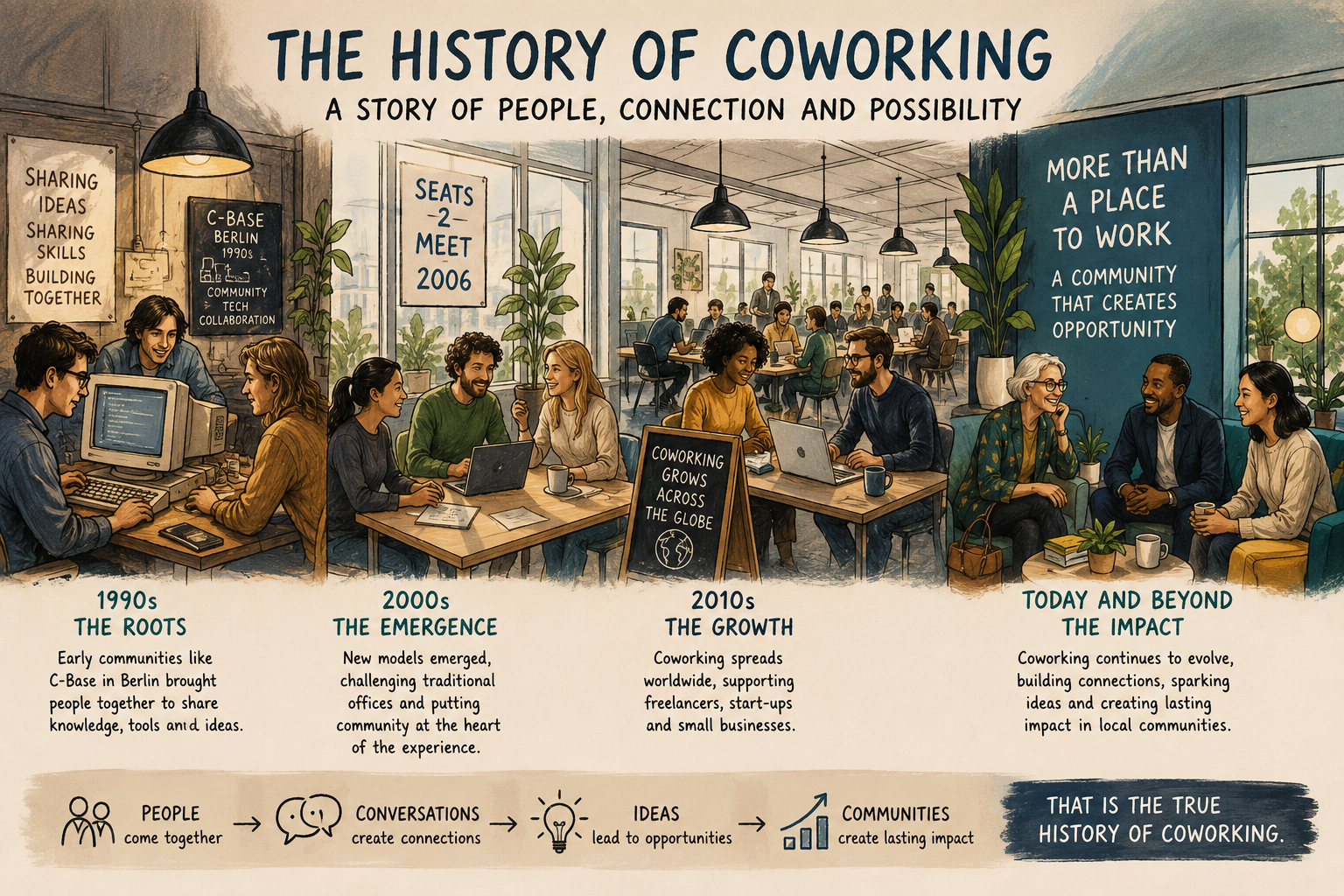
Although the term coworking was introduced in the late 1990s by Bernard DeKoven, the ideas behind it existed long before. DeKoven imagined a new way of working based on equality, collaboration, and shared participation rather than traditional workplace structures.
Early examples reflected this philosophy. In Berlin, the 1990s hackerspace C-Base brought together computer enthusiasts who shared technical knowledge, equipment, and ideas. It was not designed around renting desks; it was built around people learning from one another.
Another important milestone came with the launch of Seats2meet in the Netherlands in 2006. The model challenged the traditional idea that workspace value came only from the physical environment. Instead, users contributed knowledge, skills, and connections, creating a community where relationships became part of the value exchange.
These early examples reveal a key lesson: coworking has always been about more than providing infrastructure. A chair, desk, and internet connection can create a workplace, but they do not create a community. The real value comes from the human interactions that take place around them.
Why Social Capital Has Always Been at its Core
Coworking’s greatest value has never come from the workspace itself, but from the social capital created within it. Social capital refers to the value derived from the relationships and networks that enable people to access knowledge, support, and opportunities.
Successful coworking spaces understand that these relationships do not happen automatically. Simply placing people in the same room does not guarantee collaboration. Strong communities are created through intentional actions: introductions between members, events that encourage conversation, shared activities, and opportunities for people to exchange expertise.
This is what separates coworking from a conventional office or serviced workspace. A traditional office is often designed around organisational structures, while coworking spaces bring together people from different industries, backgrounds, and professional stages. This creates the potential for unexpected connections, such as a freelancer finding a new client, a start-up meeting a future partner, or an entrepreneur gaining advice from someone with different experience.
The history of coworking teaches us that meaningful relationships are not an additional benefit of these spaces; they are its foundation.
What Coworking’s Past Can Teach Us About Its Future
Remote and hybrid working have created greater flexibility, but they have also reduced many of the informal interactions that once happened naturally at work. Spontaneous conversations, quick introductions, and everyday knowledge-sharing require environments that deliberately create opportunities for these connections.
This is where coworking has a unique role to play. The strongest spaces are not simply offering an alternative office; they are creating communities where people can build relationships that lead to new ideas, collaborations, and opportunities.
Coworking’s purpose has always been bigger than merely providing desks. From early collaborative communities to today’s professional networks, the underlying principle remains the same: when people come together with openness, trust, and a willingness to share, new possibilities emerge.
The future of coworking will belong to the spaces that remember this lesson — that their greatest value is not measured by occupancy rates, but by the connections they help create